Navigation Under Pressure: Resilient PNT’s Role in Modern Defence
Add bookmark
GPS remains one of the most vital technological advancements in modern defence operations.
It provides precise location and timing data and supports systems across air and ground transportation, communications and weapons. However, GPS signals received from space are relatively weak by the time they reach Earth's surface.
That creates opportunities for interference.
Two of the most common modes of interference are GPS jamming and spoofing. Jamming attempts to overwhelm or block legitimate signals. Spoofing, meanwhile, is potentially more complicated because it attempts to provide false information that may appear legitimate to the receiving system.
For modern defence operations, resilient PNT is no longer simply an alternative to GPS, but an essential tool for keeping missions moving when trusted navigation cannot be taken for granted.
What is Resilient PNT?
Resilient PNT refers to an approach that enables systems to maintain trusted positioning, navigation and timing information even when their primary source, such as GPS, is disrupted, degraded or unavailable.
It combines multiple technologies and information sources to reduce reliance on any single system and support continued operations in interference-prone environments.
A platform that loses GPS may immediately alert the operator to a problem. A platform receiving false but plausible information may continue operating based on an incorrect understanding of its position.
In a contested environment, maintaining access to navigation information is important. Maintaining trust in that information may be even more important.
The challenge is therefore not simply whether a system can continue operating after GPS disappears, but also whether the system can recognise when GPS information should no longer be trusted.
This concern has grown more than ever as GPS interference moves from a theoretical battlefield concern to an operational reality. In July 2025, the European Commission noted that users in sensitive regions including the Baltic Sea, Black Sea and parts of the Middle East were experiencing position errors of hundreds of kilometres because of spoofing.
The Commission subsequently brought Galileo's Open Service Navigation Message Authentication (OSNMA) into operational service to help users verify the authenticity of navigation messages.
For defence organisations, the lesson is broader than simply adding protection to a GPS receiver. A resilient architecture must be able to identify unreliable information, compare it against other sources and maintain an operationally useful PNT picture when individual inputs become unavailable or untrustworthy.
Why is Resilient PNT Important for Defence?
Modern military operations highly depend on systems that must navigate, coordinate and act across multiple domains. If a common source of positioning or timing is disrupted, the effects can therefore extend well beyond a single platform.
The U.S. Army, for example, describes PNT as an enabler for accurate fires and the digital kill chain, while its Assured PNT work combines technologies including M-Code receivers, alternative navigation, anti-jam and anti-spoof capabilities, inertial measurement units and image-based guidance.
This is why resilience is becoming an architectural requirement rather than simply a backup function.
Resilience Through Multiple Sources
There is unlikely to be a single technology that can replace GPS in every operational environment.
Instead, resilient PNT heavily relies on a combination of technologies that can support and verify one another. These can include inertial navigation systems, alternative terrestrial signals, precision clocks and other sensors.
The advantage of this approach is not simply redundancy. There are unique pros and cons associated with various technologies and combining them will minimise dependence on only one source of information.
An inertial navigation system, for example, does not depend on any external satellites. Rather, it makes use of internal devices like accelerometers and gyros to estimate motion and calculate the location and orientation of a moving object.
This makes it particularly valuable when satellite navigation signals are unavailable.
Inertial systems are not perfect. Small errors in the measurements can accumulate over time, slowly causing the estimated position to drift. But when inertial navigation is combined with GPS or other sources of positioning information, each system can help make up for the weaknesses of the other.
The goal is not to opt for either GPS or INS, but to build a system that is capable and sufficient enough to complete the task even when either fails.
How Does Multi-Source PNT Improve Navigation Resilience?
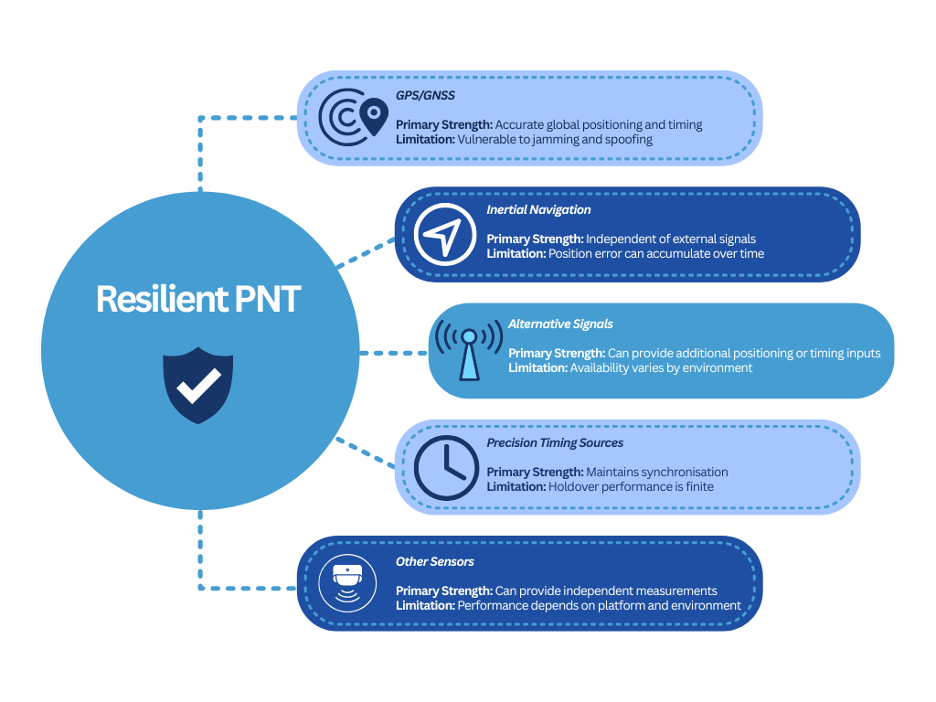
The practical direction of military development reflects this multi-source approach. In May 2025, the U.S. Air Force reported demonstrations of PNT systems in simulated GPS-denied environments, including the integration of inertial and vision-based navigation through an open architecture.
The U.S. Army has also been scaling the deployment of assured PNT capabilities. In 2025, it reported delivering approximately 27,000 M-Code-capable receivers in the preceding fiscal year, alongside more than 2,500 ground Assured PNT systems and 7,000 precision guidance kits.
These figures illustrate how resilient PNT is moving from experimentation towards fielded capability.
Timing: The Overlooked Element of PNT
Positioning and navigation are often more emphasised, however, timing is just as vital.
For communications, sensor networks, control and distribution systems, timing is essential for activity coordination and data correlation. GPS serves as a key source of accurate time. When access to satellite signals is disrupted, the consequences can therefore extend beyond a navigation display.
A loss of accurate timing can affect how distributed systems communicate and coordinate.
Resilient PNT architectures need to account for this by incorporating stable internal timing sources capable of maintaining accurate time when an external reference becomes unavailable.
This is especially important as military forces become more connected. The more systems that depend on shared information, the more important it becomes to ensure they are operating from a trusted and synchronised understanding of time.
From Backup to Operational Requirement
Resilient navigation was once often viewed primarily as a backup capability. If GPS became unavailable, another system could take over.
Today, that approach is becoming less sufficient.
In future contested environments, GPS disruption may not be an isolated event or a temporary inconvenience. It may be a deliberate and persistent part of the operating environment.
This means resilience needs to be considered at the system level. Navigation sensors, timing sources, mission computers and communications systems need to work together in a way that prevents the loss of one information source from creating a wider operational failure.
This is particularly relevant for autonomous and uncrewed systems.
As platforms operate with greater independence, they need reliable ways to determine where they are, understand their movement and maintain coordination with other assets, even when external signals are degraded.
The same principle applies to connected forces operating across land, air, sea, space and cyber domains. Reliable PNT has solidified its position as an enabling capability for the wider defence architecture.
Recent defence programmes indicate that this shift is already underway. In August 2025, Australia's Department of Defence announced that its new Joint Positioning, Navigation and Timing Directorate had reached initial operating capability.
The directorate was established specifically to help the Australian Defence Force operate when GPS is degraded or denied, reflecting the growing importance of PNT resilience at an organisational level.
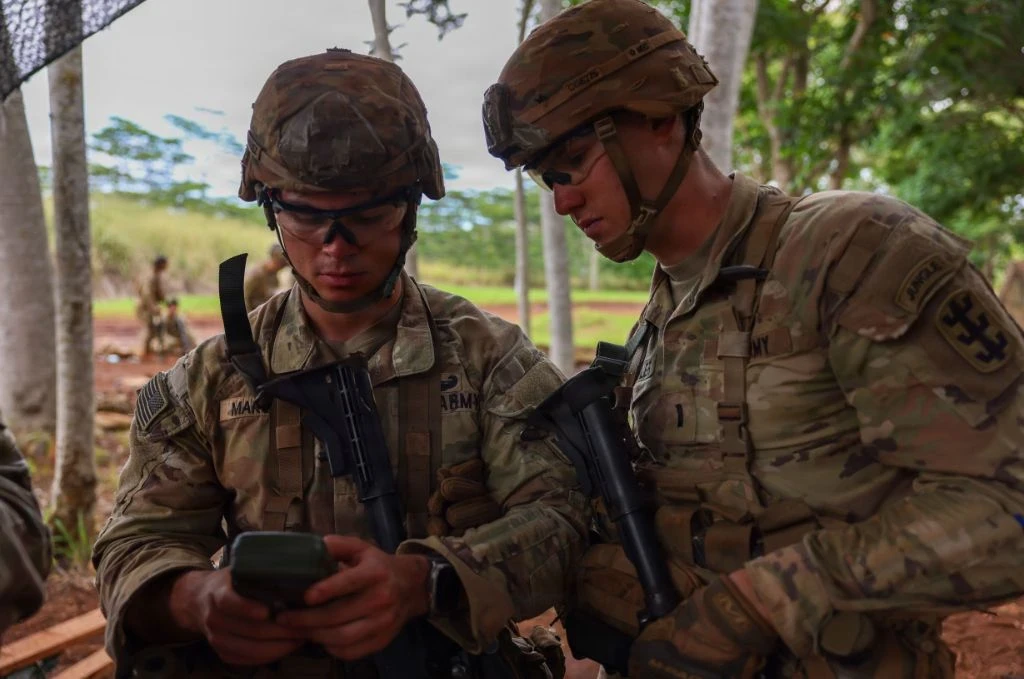
The U.S. military is pursuing a similar direction. In 2025, Space Systems Command demonstrated a next-generation handheld M-Code receiver with U.S. Army, Marine Corps, Air Force and Space Force personnel, alongside Norwegian and French participants.
The system was designed to provide improved anti-jam, anti-spoof and anti-tamper capabilities while helping warfighters identify when positioning information should not be trusted.
Uncrewed & Autonomous Systems 2026

The 2-day agenda will give you insight into the operational challenges shaping the development and deployment of uncrewed and autonomous capability. With focused sessions on UGVs, UAS, robotics, AI and autonomous systems, the programme provides a comprehensive view of the technologies and priorities driving future defence capability.
Find out more about Uncrewed & Autonomous Systems 2026 today!
Learn MorePreparing for a Contested Future
Defence organisations are already pursuing several approaches to reduce reliance on GPS alone.
GPS itself continues to evolve, including the development of more resilient military capabilities such as M-code. In parallel, military forces are exploring complementary navigation technologies that allow operations in environments where satellite signals are unavailable or unreliable.
Recent demonstrations of alternative navigation technologies illustrate the breadth of this effort.
In 2025, the U.S. Army's All Domain Persistent Experiment (APEX) included testing of resilient navigation technologies in simulated contested environments, including combinations of inertial navigation, M-Code and alternative sensors. The broader objective was to assess how multiple navigation inputs could work together when GNSS is degraded or unavailable.
Other programmes are also looking beyond traditional satellite navigation. An ESA NAVISP project completed in 2025 demonstrated a hybrid approach combining GNSS with Signals of Opportunity, including 5G, LTE and Iridium satellite signals, with the objective of improving PNT assurance when GNSS is disrupted.
These developments point towards an important change in how navigation resilience is understood. The question now is not whether an alternative to GPS exists, but how different sources can be combined, monitored and trusted according to the operational environment.
Navigation Under Pressure
The future of resilient PNT is not about eliminating GPS from military operations.
GPS will remain a highly important capability. The challenge is ensuring that military forces can continue operating when access to it is disrupted, degraded or deliberately manipulated.
That requires more than backup equipment and calls for a mode of navigation and timing that presupposes a contestable environment and incorporates resilience at the architectural level from the outset.
The strategic edge might lie heavily with forces that have the capacity to sustain trusted positioning, navigation and timing in the face of deliberate denial attempts by an adversary.
In that environment, the goal is straightforward: Navigation disruption should only complicate the mission, not stop it.