Sovereignty, Survivability and Presence in the Arctic Region
Add bookmark
1. Why has the Arctic become a renewed priority for defence and sovereignty?
Over the years, the Arctic has emerged as a strategic priority. This is due to a number of factors, such as the convergence of geopolitical competition, alliance developments and even environmental change. Once considered a relatively stable region, the Arctic has since become a critical theatre for deterrence and strategic positioning.
One of the biggest reasons has been the shift in the Euro-Atlantic security environment following Russia's invasion of Ukraine. In response, Finland and Sweden abandoned long-standing policies of military non-alignment and joined NATO, significantly strengthening the Alliance's northern posture and increasing the strategic relevance of the High North.[1]
At the same time, Russia continues to prioritise the Arctic as a key military region. It retains the most extensive military capability in the region, with its Northern Fleet forming the backbone of its maritime nuclear deterrent. In order to protect this, Russia has developed a "bastion defence concept" in the Barents Sea which ensures secure operating areas for its submarine forces. Furthermore, continuous modernisation of naval capabilities (including more advanced and harder-to-detect submarines) highlights the Arctic's importance for power projection and strategic defence.[2]
Another reason for this shift is down to environmental change, i.e. global warming. With sea ice rapidly diminishing, this has created new shipping routes and easier access to natural resources, consequently increasing competition and reinforcing the need for states to assert sovereignty.[3]
2. What does 'maintaining presence' in the Arctic actually involve?
Fundamentally, maintaining presence in the Arctic requires the ability to operate successfully across vast, remote and hostile terrain. This includes a combination of:
- Forward-deployed assets
- Regular patrols
- Sustained surveillance
- Situational awareness across land, sea and air.
A significant component here is maritime and air presence. Arctic states are investing in capabilities such as ice-capable vessels, submarines and long-range maritime patrol aircraft which help monitor key sea lanes and respond to new threats. For example, Norway is acquiring a fleet of P-8A maritime reconnaissance aircraft and developing long-endurance drones specifically designed for Arctic operations, ultimately enhancing its ability to monitor activity across the High North.[4] As the International Institute for Strategic Studies notes, Arctic military dynamics are progressively being shaped by 'presence, capability and posture'[5] with specialised assets acting as key enablers of both presence and sustainment in the region.
Equally critical is infrastructure. Ports and airfields enable forces to both deploy and respond rapidly when required. For example, NATO has recently established a Combined Air Operations Centre in northern Norway. This enhances real-time airspace monitoring and coordination across the High North thus improving the Alliance's ability to respond quickly to emerging threats.[6]
Ultimately, maintaining presence is about persistence and credibility. It signals three things: the first is control over national territory, the second is reassurance to allies and the third is that it ensures Arctic states can monitor, deter and respond effectively.
3. How are Arctic nations enhancing survivability in extreme conditions?
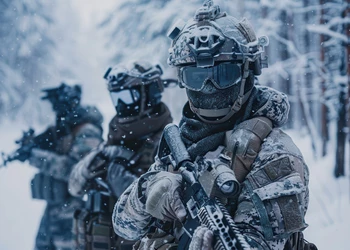
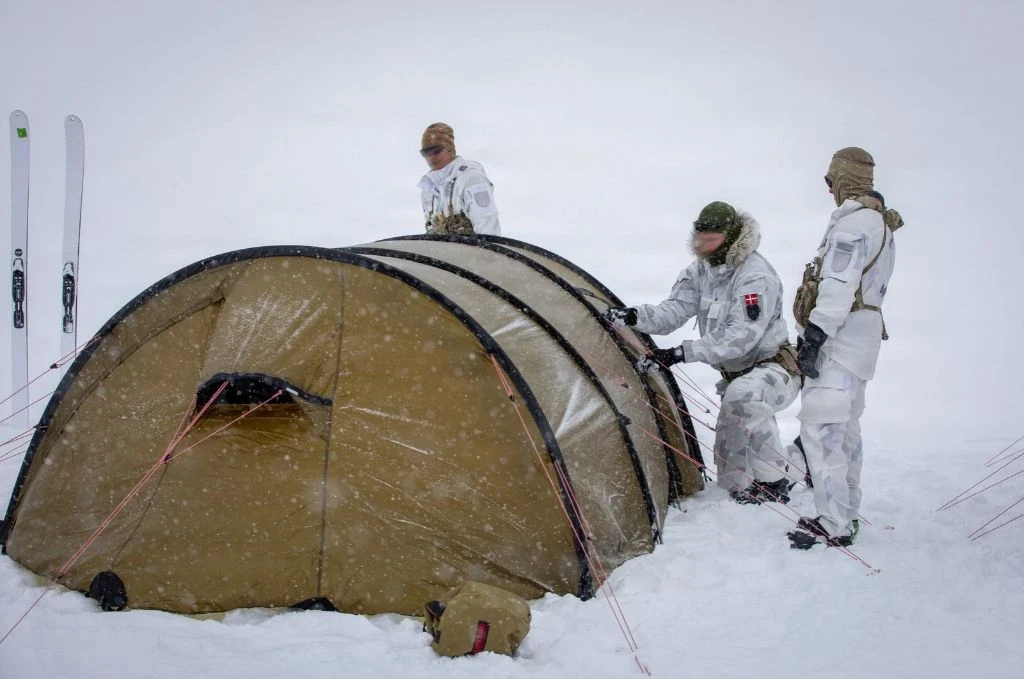
Enhancing survivability in the Arctic requires forces to operate effectively in extreme cold, limited infrastructure, and prolonged periods of isolation. To address this, Arctic nations are investing in specialised equipment, training, and platforms designed specifically for harsh environments.
The United States provides a strong example through its renewed focus on Arctic-capable forces and training. The 11th Airborne Division, based in Alaska, has been reactivated by the U.S. Army as a dedicated Arctic Unit specifically trained and equipped for cold-weather operations. This includes specialised clothing, vehicles and tactics that have all been designed to help soldiers operate and survive in sub-zero temperatures. Large-scale exercises further bolster readiness by ensuring forces can function successfully in one of the most challenging environments in the world.[7]
Another strong example comes from Canada, who has invested in Arctic mobility and infrastructure. In 2024, the Canadian government announced a multi-billion-dollar programme to establish a network of Northern Operational Support Hubs and Nodes with the ability to enable rapid deployment and sustain year-round military operations across remote regions. In addition to this, Canada is investing in new ice-capable vessels to extend operational reach in northern waters. These initiatives improve Canada's ability to maintain a persistent presence in areas where traditional infrastructure and platforms are limited.[8]
4. What role does multi-domain integration play in Arctic security?
Arctic security requires coordinated operations across land, air, maritime, cyber and space to achieve effective deterrence and situational awareness – it is inherently multi-domain. The region possesses a vast geography, exceedingly harsh climate and limited infrastructure – this means that no single domain can provide comprehensive coverage. Therefore, domain integration is essential in maintaining operational effectiveness.
We can look towards the growing emphasis on joint and combined operations within NATO as a key example. The alliance has focused more and more on enhancing situational awareness across the High North by integrating:
- Air surveillance
- Maritime patrols
- Space-based capabilities
This also includes the use of satellite systems to monitor Arctic approaches, as well as coordinated naval and air deployments to track activity across critical sea lanes. NATO's strategic outlook highlights the need to strengthen its ability to operate across all domains in the region, particularly in response to increased military activity and evolving security challenges.
Multi-domain integration also enhances resilience. By linking cyber and space assets with traditional military capabilities, Arctic nations can maintain secure communications, improve decision-making, and ensure continuity of operations in contested environments. Ultimately, integration is fundamental in maintaining a credible and responsive security posture in the Arctic.[9]
5. How can allied cooperation strengthen sovereignty and deterrence in the Arctic?
Allied cooperation strengthens Arctic sovereignty and deterrence due to:
- Shared intelligence
- Interoperable capabilities
- Coordinated deployments
Due to the vast, remote and increasingly contested Arctic region, unilateral action is often insufficient. However, when nations operate collectively, this significantly enhances a persistent presence that reinforces territorial control and deters potential adversaries.
A strong example is the Arctic Challenge Exercise (ACE)[10] which is one of the largest multinational air exercises conducted in Northern Europe. Hosted by the Nordic nations (Norway, Sweden, and Finland) the exercise assembles NATO allies to conduct air operations across the High North. The exercise integrates:
- Advanced fighter aircraft
- Airborne surveillance systems
- Command-and-control structures
As a result, this allows participating forces to train in realistic Arctic conditions while improving interoperability and coordination.
By operating across national boundaries and in a complex environment, ACE demonstrates how allied air power can be rapidly combined to monitor and defend strategically important areas. Cooperation such as this sends a clear signal of collective resolve. It ensures that Arctic nations can act as a unified force and significantly enhance deterrence by increasing both the scale and credibility of their response to emerging threats. Prior to the 2023 exercise, the detachment commander, Wing Commander Mark Robertson said:
"The large, complex, multinational exercise offers an excellent opportunity for high quality training with a range of partners. Working with our Joint Expeditionary Force partners is important to develop interoperability and ensure that we are fully prepared to defend against any threats."
Bibliography
- "Finland to Join NATO in Major Security Shift." BBC News, July 11, 2023. https://www.bbc.co.uk/news/world-europe-61397478. Accessed April 6, 2026.
- "Has Military Activity in the Arctic Increased After 2022?" NUPI, August 25, 2025. https://www.nupi.no/en/news/has-military-activity-in-the-arctic-increased-after-2022. Accessed April 7, 2026.
- "Security and the Arctic: Navigating Between Cooperation and Competition." International Institute for Strategic Studies, December 10, 2021. https://www.iiss.org/research-paper/2021/12/security-and-the-arctic-navigating-between-cooperation-and-competition. Accessed April 8, 2026.
- "NATO's Arctic Seven Find Strength in Numbers." The American Legion, October 8, 2025. https://www.legion.org/information-center/news/landing-zone/2025/october/natos-arctic-seven-find-strength-in-numbers. Accessed April 9, 2026.
- "Security and the Arctic." International Institute for Strategic Studies, December 2021. https://www.iiss.org/globalassets/media-library---content--migration/files/research-papers/2021/security-and-the-arctic.pdf. Accessed April 10, 2026.
- "Arctic Security." North Atlantic Treaty Organization, February 16, 2026. https://www.nato.int/cps/en/natohq/topics_50091.htm. Accessed April 11, 2026.
- "Soldiers Train to Enable Arctic Dominance During Cold Weather Course in Alaska." U.S. Indo-Pacific Command, January 19, 2024. https://www.pacom.mil/Media/News/Article/3651145/soldiers-train-to-enable-arctic-dominance-during-cold-weather-course-in-alaska/. Accessed April 12, 2026.
- "Northern Operational Support Hubs." Government of Canada, March 13, 2026. https://www.canada.ca/en/department-national-defence/services/northern-operational-support-hubs.html. Accessed April 13, 2026.
- Secretary General's Annual Report 2025. North Atlantic Treaty Organization, 2025. https://www.nato.int/nato_static_fl2014/assets/pdf/2025/6/pdf/250601-sgar-en.pdf. Accessed April 14, 2026.
- "Exercise Arctic Challenge." Royal Air Force, May 19, 2023. https://www.raf.mod.uk/news/articles/exercise-arctic-challenge/. Accessed April 15, 2026.