Exclusive Content

International Dismounted Soldier Interactive Market Report 2026
The International Dismounted Soldier Interactive Market Report provides a comprehensive overview of the evolving global dismounted soldier market, exploring the key programmes, procurement priorities and capability developments shaping the future of the individual warfighter. Through an interactive format, the report highlights investment trends, emerging requirements and opportunities across areas including soldier systems, lethality, protection, communications and situational awareness.

International Dismounted Soldier Global Market Report 2026-2031
The International Dismounted Soldier Global Market Report 2026–2031 provides an in-depth overview of the evolving dismounted soldier market, examining key capability priorities, procurement programmes and investment trends worldwide. It explores how armed forces are modernising soldier systems across areas including weapons, protection, communications, situational awareness and digital technologies, highlighting the developments shaping future dismounted operations through 2031.

Beyond the Rifle: Rethinking the Dismounted Soldier For the Future Battlefield
Ahead of Defence iQ's International Dismounted Soldier Conference 2026, we spoke with Major Sebastian Langvad, Teacher of Complex Operations at the Norwegian Defence University College, about the experiences shaping his view of modern land warfare. Drawing on a career spanning intelligence, light infantry, deployments in Afghanistan and the Middle East, and Arctic operations in Northern Norway, Major Langvad discusses the importance of stealth and adaptability, how forces can turn extreme environments into a tactical advantage, the relationship between territorial and allied forces, and why militaries may need to rethink the role of the human soldier as unmanned capabilities advance.
International Dismounted Soldier Post Show Report 2025
The International Dismounted Soldier Conference returned to London on the 28th–29th October 2025, bringing together military leaders, capability developers, procurement specialists, researchers, and industry partners at the Millennium Gloucester Hotel to examine one of the most pressing challenges facing modern land forces: how to prepare, equip, and support dismounted soldiers for an increasingly complex and transparent battlefield.
The 2025 conference welcomed representatives from 19 nations and featured more than 30 expert speakers drawn from military organisations, government agencies, NATO bodies, research institutions, and industry. Attendees included representatives from organisations such as NATO, the British Army, the U.S. Army, and the NATO Support and Procurement Agency (NSPA), alongside senior decision-makers holding appointments including Deputy Chief of the Defence Staff, Chief Procurement Officer, and Director, Close Combat Lethality Task Force. Across two days of presentations, panel discussions, and networking sessions, participants shared lessons learned, examined emerging capability requirements, and explored approaches to strengthening dismounted force effectiveness for future operations.
This Post Show Report captures the key themes, insights, and takeaways from the conference. It provides an overview of the discussions that took place and reflects on the challenges and opportunities facing military organisations as they seek to develop combat-ready soldiers capable of operating effectively across the evolving battlefields of tomorrow.
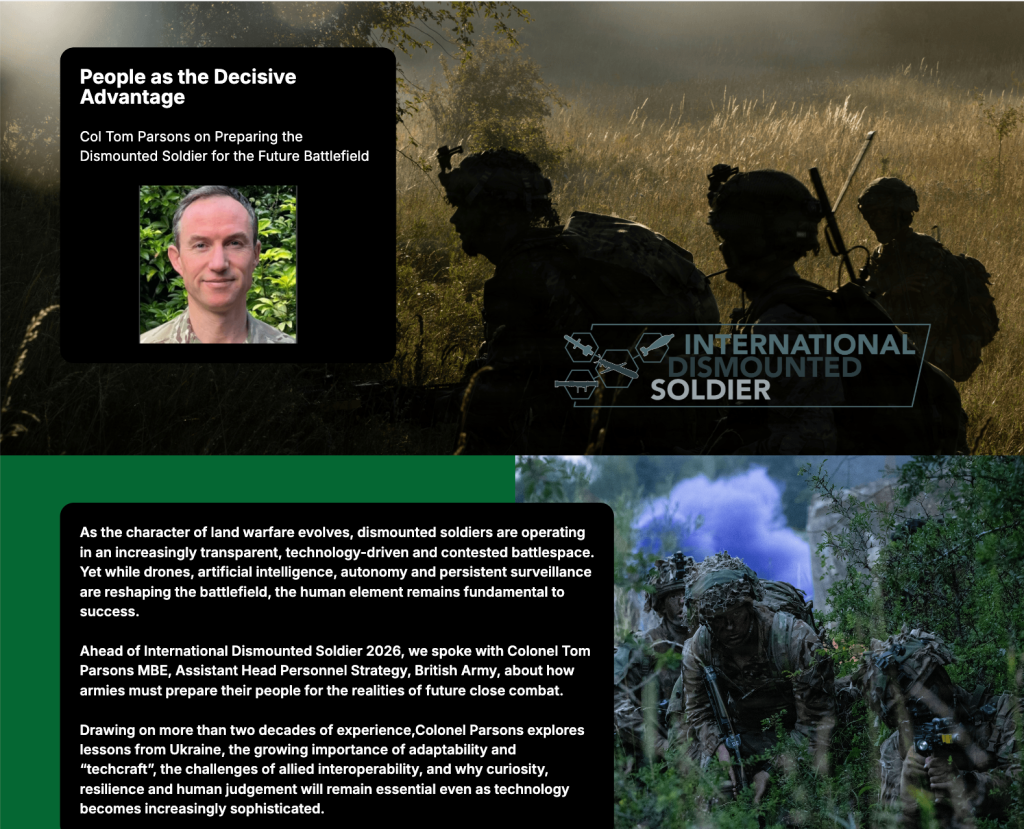
People as the Decisive Advantage: Col Tom Parsons on Preparing the Dismounted Soldier for the Future Battlefield
As the character of land warfare evolves, dismounted soldiers are operating in an increasingly transparent, technology-driven and contested battlespace. Yet while drones, artificial intelligence, autonomy and persistent surveillance are reshaping the battlefield, the human element remains fundamental to success. Ahead of International Dismounted Soldier 2026, we spoke with Colonel Tom Parsons MBE, Assistant Head Personnel Strategy, British Army, about how armies must prepare their people for the realities of future close combat. Drawing on more than two decades of experience, Colonel Parsons explores lessons from Ukraine, the growing importance of adaptability and "techcraft", the challenges of allied interoperability, and why curiosity, resilience and human judgement will remain essential even as technology becomes increasingly sophisticated.

International Dismounted Soldier Market Report 2025-2029: Selected Market
Read Defence IQ’s latest International Dismounted Soldier 2025 Market Report for exclusive insights into the future of infantry modernisation. Covering selected markets from 2025 to 2029, this in-depth analysis explores key technologies, global procurement trends, and strategic investment priorities across 11 leading nations. Essential reading for defence professionals and industry suppliers operating in the soldier systems space.

Trials and Development; Interview with Lieutenant Colonel Arthur Dawe Commanding Officer, Infantry Trials and Development Unit, British Army
In this exclusive interview, Lieutenant Colonel Arthur Dawe, Commanding Officer of the Infantry Trials Development Unit discusses the future of the British Armed Forces as it modernises and digitises. Dawe also provides insight into the impact of technologies such as AI and ML on the battlefield. Read the 8 minute interview now to learn more about the projects transforming the way British Land Forces conduct operations in the tactical environment.

Lessons From Ukraine
The War in Ukraine shows the clear importance of the dismounted soldier in contemporary warfare. In many respects, it demonstrates the value of personal training, communication, and firepower on the modern battlefield. Ukrainian defence expert, Pavlo Khoma, shares the lessons learned from the beginning of the invasion, delivering a unique insight into how things have changed in modern warfare but also how things remain the same.
In Partnership With:

QUESTIONS?
Address: IQPC Ltd, 129 Wilton Road,
London SW1V 1JZ
Telephone: +44 (0) 113 210 042
Fax: 44 (0) 207 368 9301
Email: enquire@iqpc.co.uk

©2026 IQPC. All rights reserved.