
Asia's Leading Platform for Critical Underwater Infrastructure Protection 25 - 26 February 2027 l Singapore
Media Center
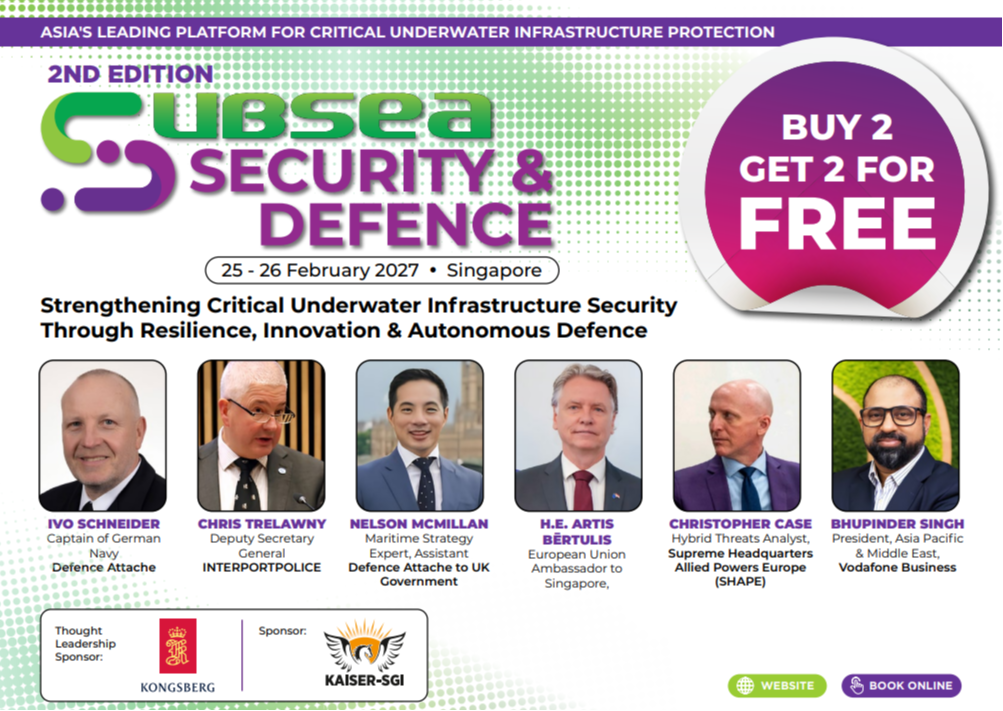
Subsea Security & Defence 2027 Agenda Brochure
Download the Subsea Security & Defence 2027 Agenda Brochure25–26 February 2027 | Singapore Get the full agenda and discover what's shaping the future of subsea security and defence. Inside the brochure:Full 2027 p ...
Featured Content
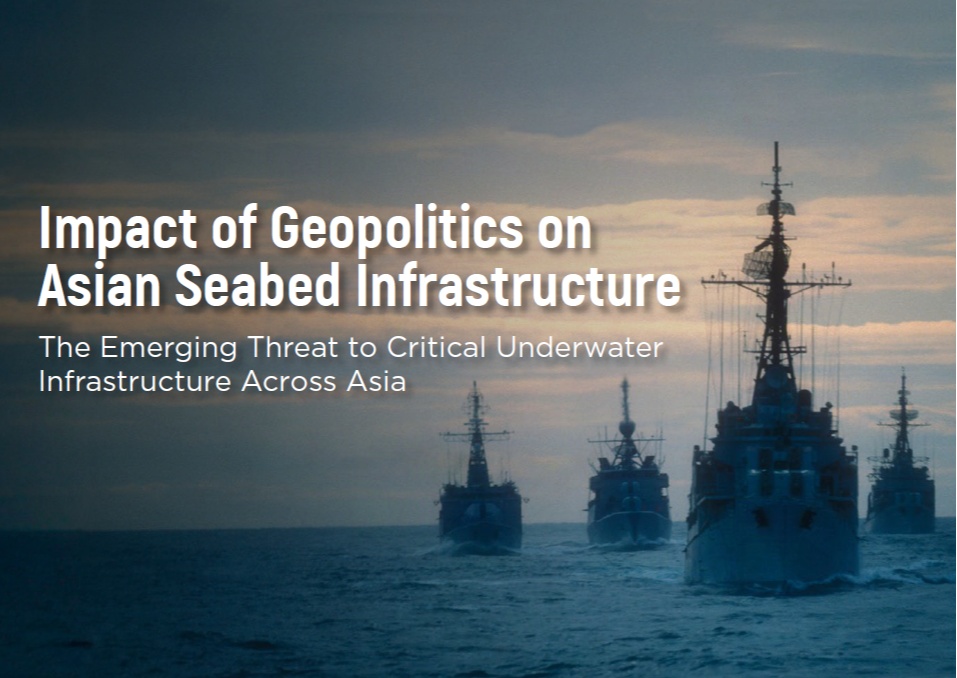
Impact of Geopolitics on Asian Seabed Infrastructure
The seabed is becoming a new frontier of geopolitical competition.
Subsea cables, energy pipelines and critical underwater infrastructure underpin the global economy, yet much of this infrastructure remains difficult to monitor, defend and repair. As geopolitical tensions, maritime activity and contested waters intensify, the risk of disruption is no longer limited to conventional conflict.
Download the report to explore the emerging geopolitical risks facing Asia's seabed infrastructure, including the evolving threat landscape across the Baltic Sea, Red Sea, South China Sea and Strait of Hormuz, as well as the potential vulnerabilities emerging around the Strait of Malacca. Gain insight into the key risk factors shaping subsea security, from deliberate disruption and hybrid warfare to accidental damage, infrastructure concentration and limited underwater visibility — and understand why greater collaboration between defence, government, telecommunications, energy, maritime and technology stakeholders is becoming increasingly critical.
Discover where geopolitical pressure meets critical infrastructure — and what it means for the future of subsea security across Asia.
![Watching the Dark Water [Report]](https://eco-cdn.iqpc.com/eco/images/event_content/kO2k1rrlNaYzEFYqErfweLcPfTi7NryP6EV3x4hN.png)
Watching the Dark Water [Report]
Why Persistent Seabed Monitoring Has Become a Strategic Imperative
Subsea infrastructure has become one of the most economically critical, yet least visible, domains in the global security landscape.
More than 99% of international data exchanges rely on submarine cables, while an estimated $10 trillion+ in financial transactions rely on submarine cable connectivity each day. At the same time, critical pipelines, electricity interconnectors and offshore energy infrastructure continue to expand across the seabed.
But the ability to monitor and protect this infrastructure has not developed at the same pace.
What You'll Discover:
- Critical subsea infrastructure
Explore the cables, pipelines, power interconnectors and offshore assets underpinning the global economy. - The cost of inadequate protection
Examine real-world cable outages, infrastructure disruption and repair challenges. - Lessons from asymmetric warfare
Discover what Black Sea drone warfare could mean for future subsea security. - The technologies closing the monitoring gap
Explore Unmanned surface, underwater vehicles, sonar and acoustic sensing, subsea positioning and navigation, diving and human-intervention capabilities - The future of hybrid subsea fleets
Examine how crewed, uncrewed and autonomous systems can work together to enable persistent subsea monitoring.
Download the Free White Paper
Watching the Dark Water: Why Persistent Seabed Monitoring Has Become a Strategic Imperative — and the Industrial Base Rising to Meet It
This new white paper examines how the subsea security environment is evolving, and what operators, defence organisations and technology providers need to consider as persistent monitoring becomes increasingly important.

Asia-Pacific Maritime Defense Outlook 2025: A Strategic Update
The maritime defense landscape of the Asia-Pacific in 2025 has evolved into a complex matrix of high-stakes deterrence, technological acceleration, and shifting alliances. Regional waters are now defined not only by traditional naval power projection, but also by cyber warfare, unmanned systems, and contested infrastructure such as undersea cables and energy corridors. Emerging technologies—such as AI-powered ISR platforms, satellite-aided surveillance, and UAVs—are becoming central to defense modernization, while undersea infrastructure like communication cables and energy routes are increasingly targeted for disruption or protection.
Check out our latest updates on APAC's maritime defense strategies, technological innovations and scenarios to protect undersea cables and energy pipelines.

The Latest in Radar and Optronics
The maritime defense landscape in 2025 has rapidly evolved with the integration of advanced radar and optronic technologies. With increased geopolitical tensions, grey-zone tactics, and asymmetric threats such as UAVs and small boat intrusions, navies worldwide are adopting next-generation sensors and intelligent platforms. Radars in 2025 leverage AESA arrays, GaN technology, and machine learning algorithms for enhanced detection, clutter reduction, and multitarget tracking. Major players like HENSOLDT, Leonardo, Thales, and Elbit Systems are leading this shift. Notably, the move from traditional hardware-driven monitoring to software-defined and modular platforms has made modern systems more adaptive, agile, and scalable for evolving mission demands
Sponsorship & Exhibition
![Watching the Dark Water [Report] (Solution Providers)](https://eco-cdn.iqpc.com/eco/images/event_content/BqTMsn6iNc7RsYUKTDGERZ7Zc8wGU4gPOSHkDisG.png)
Watching the Dark Water [Report] (Solution Providers)
Why Persistent Seabed Monitoring Has Become a Strategic Imperative
Subsea infrastructure has become one of the most economically critical, yet least visible, domains in the global security landscape.
More than 99% of international data exchanges rely on submarine cables, while an estimated $10 trillion+ in financial transactions rely on submarine cable connectivity each day. At the same time, critical pipelines, electricity interconnectors and offshore energy infrastructure continue to expand across the seabed.
But the ability to monitor and protect this infrastructure has not developed at the same pace.
What You'll Discover:
- Critical subsea infrastructure
Explore the cables, pipelines, power interconnectors and offshore assets underpinning the global economy. - The cost of inadequate protection
Examine real-world cable outages, infrastructure disruption and repair challenges. - Lessons from asymmetric warfare
Discover what Black Sea drone warfare could mean for future subsea security. - The technologies closing the monitoring gap
Explore Unmanned surface, underwater vehicles, sonar and acoustic sensing, subsea positioning and navigation, diving and human-intervention capabilities - The future of hybrid subsea fleets
Examine how crewed, uncrewed and autonomous systems can work together to enable persistent subsea monitoring.
Download the Free White Paper
Watching the Dark Water: Why Persistent Seabed Monitoring Has Become a Strategic Imperative — and the Industrial Base Rising to Meet It
This new white paper examines how the subsea security environment is evolving, and what operators, defence organisations and technology providers need to consider as persistent monitoring becomes increasingly important.
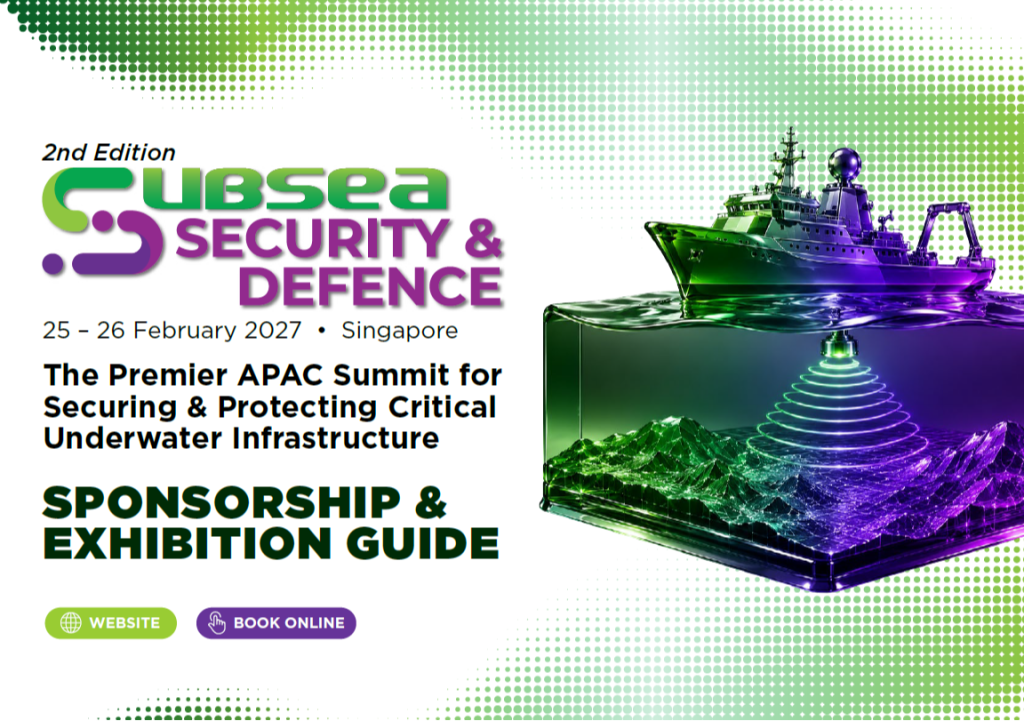
Subsea Security & Defence 2027 Sponsorship & Exibition Guide
Download the Sponsorship & Exhibition Guide
Position your organisation at the forefront of Critical Underwater Infrastructure Protection. Discover how Subsea Security & Defence 2027 connects you with senior defence leaders, government agencies, critical infrastructure owners and maritime technology innovators shaping the future of underwater security.
Inside the guide, you'll discover:
- Why APAC matters – The market drivers, geopolitical trends and investment opportunities shaping the underwater security landscape.
- Who you'll meet – Audience demographics, industry breakdown and key decision-makers attending the summit.
- 2026 event highlights – Attendee profile, participating organisations and regional representation.
- Sponsorship opportunities – Thought leadership, exhibition, branding and networking packages to maximise your visibility.
- Exclusive branding options – Premium sponsorships including Foundation Partner, Registration Sponsor, Lanyard Sponsor, Cocktail Reception Sponsor and more.
- Partnership solutions – Custom content marketing, exhibition and bespoke engagement opportunities tailored to your business objectives.
Download the Sponsorship & Exhibition Guide to explore how your organisation can engage with the region's leading platform for securing and protecting critical underwater infrastructure.
In Partnership With:

QUESTIONS?
Contact us via email at enquiry@iqpc.com.sg.

©2026 IQPC. All rights reserved.