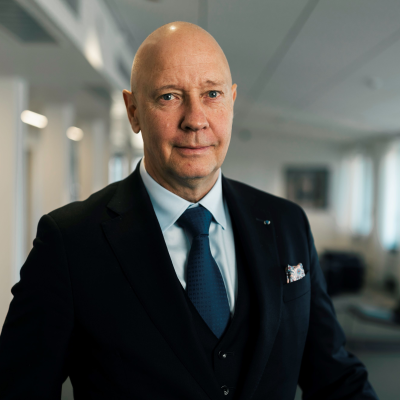
Major General (Retd.) Karl Engelbrektson
Commander Swedish Army
Karl L. E. Engelbrektson currently runs Generalship AB, providing services in consulting, executive education, coaching, and keynote speaking. He is a retired Major General with 42 years of service in the Swedish Army. He was promoted to Major General in 2005 at the age of 43 and served as Chief of the Swedish Army from June 2016 until his retirement in June 2023. He has served as Sweden’s representative to both the EU and NATO and led the negotiations for Sweden’s NATO Partnership Agreement (the so-called “Golden Card”). Karl is an experienced board member and senior business advisor. He currently serves as Chairman of Sparc Group AB (infrastructure and installation), Board Member of Wallenstam AB (a major real estate company), and Senior Advisor to Volvo Defence, Ramudden Global (traffic safety), the Stockholm School of Economics (SSE), and Finserve Global Security Fund. Major General Karl L. E. Engelbrektson was born in 1962. He is married to Sofi and they have two sons, Oscar and Eric. Karl Engelbrektson began his military career in 1981 at the Bohuslän Regiment (I17) as a conscript rifleman. He graduated from the Infantry Officers Course in 1984. During his career he has commanded at all levels from platoon to brigade, including serving as a military district commander and ultimately as Commander of the Army. He graduated from the Swedish National Defence College in 1996.
Since then, he has served in all major branches of the Swedish Armed Forces Joint Headquarters, including Military Intelligence, Personnel, Force Generation, Strategic Planning, and Operations. Karl has extensive experience of working in and with multilateral institutions at both the politico-military level and as a commander, primarily within the EU and NATO, but also in cooperation with the UN, AU, and OSCE. During 1996–1997 he served at the Swedish Ministry of Defence, where he helped organise the first desk for EU military affairs. During this time he was also responsible for arms control issues related to the OSCE. During the Swedish Presidency of the Council of the European Union in 2001, he held an expert position at the EU desk in the Swedish Joint Headquarters. In 2003–2004 he served as Commanding Officer of the Swedish Battalion in Kosovo. During this command he experienced the Kosovo crisis during the March 2004 unrest in Čaglavica, operating closely with units from Czechia, Finland, Ireland, Norway, Slovakia, the United Kingdom, and the United States. In 2005 he was assigned to establish the Swedish-Finnish-Norwegian-Irish-Estonian EU Battlegroup, with the designated Operational Headquarters in the United Kingdom. From 2006 until September 2008 he served as Force Commander of the Nordic Battlegroup (NBG 08).
In parallel, he also served as Deputy Commander at the German EU Force Headquarters in Ulm. Building on his multilateral politico-military experience from the EU Battlegroups, he later served as a senior mentor to the East African Standby Force. From 2010 to 2013 he served as Sweden’s Military Representative to the EU and NATO. During this period he was involved in a number of major international initiatives, including the European Council on Defence (2013), EU Operation Atalanta, EU Training Missions, and on the NATO side Sweden’s participation in ISAF and Operation Unified Protector in Libya. Engelbrektson also served as Co-Chairman (together with Belgium) of the NATO Connected Forces Initiative Task Force (2013–2014), successfully negotiating new partnership arrangements on behalf of seven partner nations (Australia, Austria, Finland, Ireland, New Zealand, Sweden, and Switzerland) ahead of the NATO Summit in Wales. ¨From 2014 to 2016 he served as Director of Training, Education and Force Development in the Swedish Armed Forces. He concluded his final seven years of service as Commander of the Swedish Army, responsible for both force generation and operations. During this period the Swedish Army underwent significant structural reform and modernisation, transitioning from a battalion-based organisation to a brigade-based structure with divisional command capability, including all major war-fighting functions.
This transformation was guided by a clear development strategy: “4+1+1+ Functions” — four brigades, one battlegroup on Gotland, one divisional command, and strengthened war-fighting functions across the force.He left the Army in conjunction with the celebration of the 500th anniversary of the Swedish Army on 15 June 2023. Karl Engelbrektson has held and continues to hold several positions of trust. He is a Member of the Royal Swedish Academy of War Sciences, a member of the Swedish Foreign Policy Society, and a Senior Fellow of New Westminster College, Canada. He has received decorations and medals from France, the United States, Germany, Finland, Norway, and Ukraine. In addition to 7.5 years of formal military education in Sweden, including studies at the National Defence University, Engelbrektson studied at the Geneva Centre for Security Policy (1999–2000) and at the Royal College of Defence Studies in London (2009). Engelbrektson is recognised for his in-depth knowledge and practical expertise in leadership. He is co-author of the book “In Business and Battle: Strategic Leadership in the Civilian and Military Spheres.” He has conducted extensive studies in the fields of security policy, international relations, management, leadership, and gender perspectives in defence. He frequently lectures on these topics and has spoken at several of the world’s leading security policy organisations and institutions. Outside of his professional activities, he enjoys spending time with his family, outdoor activities, physical exercise, and working on his summer cottage. He has also played poor golf on many excellent courses around the world.
Check out the incredible speaker line-up to see who will be joining (Retd.) Karl.
Download The Latest AgendaIn Partnership With:
QUESTIONS?
Address: IQPC Ltd, 129 Wilton Road,
London SW1V 1JZ
Telephone: +44 (0) 113 210 042
Fax: 44 (0) 207 368 9301
Email: enquire@iqpc.co.uk

©2026 IQPC. All rights reserved.